Most people use "clean," "sanitize" and "disinfect" like they mean the same thing. They don't. Knowing the difference saves money, keeps harsh chemicals off surfaces that don't need them, and makes sure the ones that do need them actually get the job done.
The short version
| Term | What it does | Official source |
|---|---|---|
| Cleaning | Removes dirt, organic matter and most germs with soap or detergent and scrubbing | CDC, EPA |
| Sanitizing | Kills bacteria on surfaces with chemicals. Not intended to kill viruses | EPA |
| Disinfecting | Kills viruses and bacteria on surfaces with chemicals | EPA |
Cleaning: the step you can't skip
CDC puts it simply: cleaning removes most germs, dirt and impurities from surfaces, and you do it with water, soap and scrubbing.
Here's the part people are surprised by. According to CDC, cleaning alone removes most harmful viruses or bacteria from surfaces in a typical home. For everyday kitchens, bathrooms and floors, good cleaning is the foundation.
It's also the step that makes the others work. Disinfectant sprayed on a greasy counter has to fight through the grime before it reaches the germs.
Sanitizing: bacteria only
The EPA defines sanitizing as killing bacteria on surfaces with chemicals, and it notes that sanitizing is not intended to kill viruses. Sanitizers are common for food-contact surfaces and kitchen use. They're not the right choice when you're dealing with a stomach bug or a cold going around the house.
Disinfecting: when someone is sick
Disinfecting kills viruses and bacteria with chemicals. CDC recommends disinfecting at home when someone is sick, or when someone in the home is at higher risk of getting sick, for example because of a weakened immune system.
That means you don't need to bleach every surface every day. You do want to step it up when:
- someone has the flu, a cold or a stomach virus
- a family member is recovering from surgery or treatment
- you have a newborn or an older relative with health issues
- there has been raw meat, vomit or other body fluids on a surface
The label detail most people miss
This is where a lot of home disinfecting fails. Both CDC and EPA point to contact time: the amount of time the surface has to stay wet for the product to work.
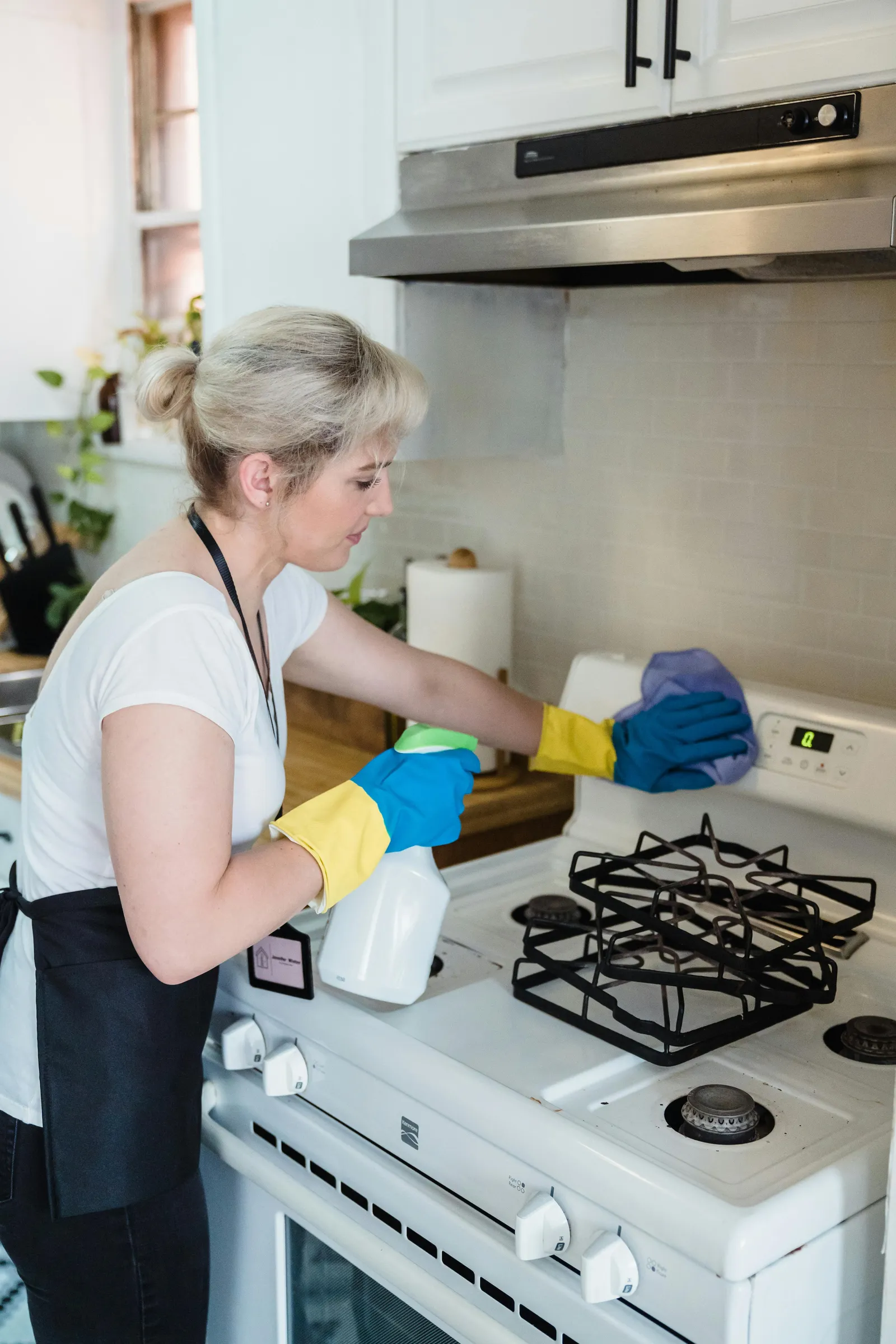
Spray and wipe right away, and you've mostly just cleaned. Check the label, leave the product on for the time it lists, then wipe or rinse as directed.
A few more label habits from the EPA:
- Look for the EPA Reg. No. Registered sanitizers and disinfectants carry an EPA registration number on the label.
- Follow the directions exactly. EPA labels carry this line: it is a violation of federal law to use the product in a manner inconsistent with its labeling.
- Never mix products. CDC says it plainly: do not mix products or chemicals with each other. Some combinations release toxic gases.
A simple routine for most homes
- Clean first with soap or a general cleaner. Remove crumbs, grease and grime.
- Rinse if the surface touches food or if the label says to.
- Disinfect only where it matters (high-touch spots, bathrooms, raw-meat prep areas, sick rooms) and respect the contact time.
- Ventilate and store products out of reach of kids and pets.
How we handle it
Our crews clean first, every time, and use disinfecting products the way the label says to. If you have a newborn, allergies or pets, or you prefer eco-friendly products, tell us and we'll adjust. A regular house cleaning keeps the everyday germs down, and a deep clean is a smart reset after an illness has worked its way through the family.
Serving Union, Essex, Middlesex, Hudson, Somerset and Morris counties. Get a free quote.
Want a cleaner, healthier space without the work?
Union's Cleaning Services sends insured, background-checked crews to homes and businesses across Union, Essex, Middlesex, Hudson, Somerset and Morris counties. Tell us what you need and we'll send a free quote, usually the same day.
Frequently asked questions
What is the difference between cleaning and disinfecting?
Cleaning uses soap or detergent and scrubbing to remove dirt and most germs. Disinfecting uses chemicals to kill viruses and bacteria left on a surface. CDC says cleaning alone removes most harmful germs, and disinfecting is for times when someone is sick or at higher risk.
Is a sanitizer the same as a disinfectant?
No. According to the EPA, sanitizing kills bacteria on surfaces and is not intended to kill viruses. Disinfecting kills both viruses and bacteria.
What is contact time on a disinfectant?
Contact time is how long a surface has to stay wet with the product to kill germs. It's printed on the label and can be several minutes, so spraying and wiping immediately may not disinfect.
How do I know a disinfectant is EPA-registered?
Look for the EPA Reg. No. on the product label. EPA registers sanitizers and disinfectants, and it is a violation of federal law to use them in a way that doesn't match the label.