
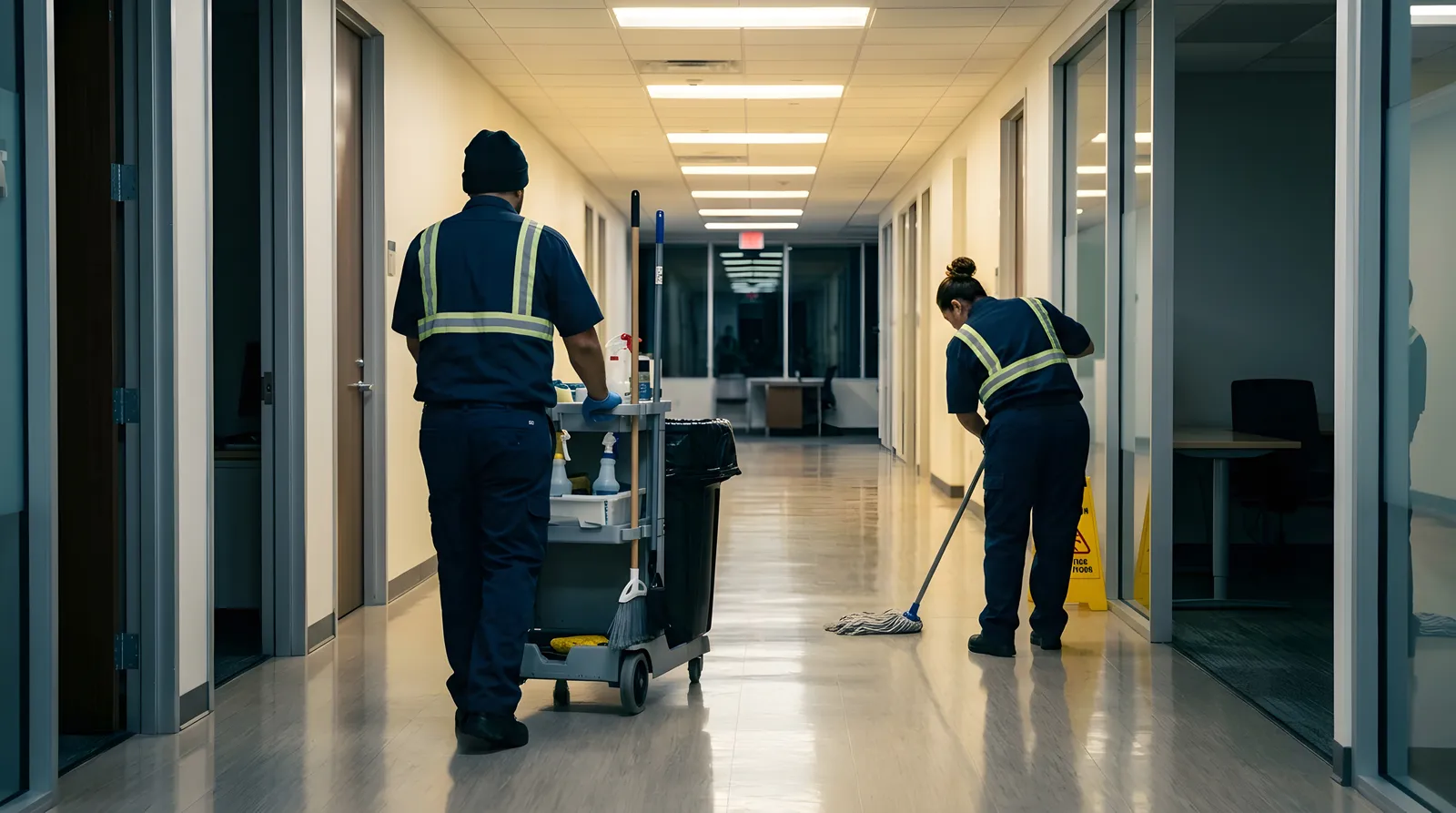
A wet floor sign helps. A floor that isn't slippery in the first place helps more. For offices, shops, warehouses and restaurants, floor care isn't only about looks. It's one of the easiest ways to prevent injuries.
The numbers behind workplace falls
According to the Bureau of Labor Statistics, falls, slips and trips caused 479,480 private-industry injury and illness cases with days away from work in 2023-2024. That's roughly a quarter of all 1,834,600 such cases, and the median time away was 13 days, compared with 8 days across all types of incidents.
The fatal numbers are sobering too. BLS reports that fatal falls, slips and trips dropped 4.6 percent to 844 in 2024, out of 5,070 total fatal work injuries. Most were falls to a lower level, but 150 were slips, trips or falls on the same level, the kind that happen on an ordinary floor.
Behind every one of those cases is a person out of work, a workers' comp claim and a team covering the gap.
What OSHA requires
OSHA's general industry rule for walking-working surfaces, 29 CFR 1910.22, is straightforward:
- All workplaces, passageways, storerooms, service rooms and walking-working surfaces must be kept clean, orderly and sanitary.
- The floor of each workroom must be kept clean and, to the extent feasible, dry.
- Walking-working surfaces must be kept free of hazards like sharp or protruding objects, loose boards, corrosion, leaks, spills, snow and ice.
Clean, dry floors aren't a nice-to-have. They're part of the baseline.
Where floors get dangerous
- Entrances in rain and snow. New Jersey winters bring slush, salt and meltwater right through the door.
- Restrooms, where water around sinks and toilets builds up.
- Break rooms and kitchens, with spilled drinks, food and grease.
- Warehouses and loading docks, with dust, debris, oil and shrink wrap.
- Freshly mopped floors with too much water or the wrong product.
- Waxed or finished floors that were not maintained properly.
A floor care plan that reduces risk
Daily
- Sweep or dust-mop to remove grit, which makes floors slippery and wears finishes down
- Spot-clean spills right away, and use signs while floors are wet
- Clean restrooms and break room floors
- Shake out or vacuum entry mats
Weekly
- Machine-scrub or deep-mop high-traffic hard floors
- Degrease kitchen and loading dock floors
- Check for loose tiles, torn mats and damaged thresholds and report them
Seasonally
- Add extra entry matting before winter
- Remove salt residue regularly during snow season
- Strip, refinish or deep clean floors as the surface requires
- Power wash sidewalks, entrances and dock areas
Good habits for any crew
- Use the right cleaner at the right dilution. Too much product can leave a slick film.
- Mop in sections so people have a dry path.
- Clean during low-traffic hours when possible.
Let the professionals keep your floors safe
Union's Cleaning Services handles office cleaning, janitorial services and warehouse and industrial cleaning for businesses across Union, Essex, Middlesex, Hudson, Somerset and Morris counties. We schedule around your operation, and our crews are insured and background-checked.
Your safety program is still yours to run. We make the clean, dry floor part easy. Get a free quote.
Want a cleaner, healthier space without the work?
Union's Cleaning Services sends insured, background-checked crews to homes and businesses across Union, Essex, Middlesex, Hudson, Somerset and Morris counties. Tell us what you need and we'll send a free quote, usually the same day.
Frequently asked questions
What does OSHA require for workplace floors?
OSHA's 29 CFR 1910.22 requires workplaces to be kept clean, orderly and sanitary, workroom floors to be kept clean and, to the extent feasible, dry, and walking-working surfaces to be free of hazards such as leaks, spills, snow and ice.
How many workplace injuries are caused by slips, trips and falls?
In private industry for 2023-2024, BLS counted 479,480 cases involving days away from work caused by falls, slips and trips, with a median of 13 days away from work.
How many workers died from falls in 2024?
BLS reports 844 fatal falls, slips and trips in 2024, down 4.6 percent from 885 in 2023. Of those, 150 were slips, trips or falls on the same level.
How often should commercial floors be cleaned?
High-traffic entrances, restrooms, break rooms and food areas usually need daily attention, with deeper scrubbing and floor care on a regular schedule. Warehouses and busy retail spaces may need cleaning during and after each shift.